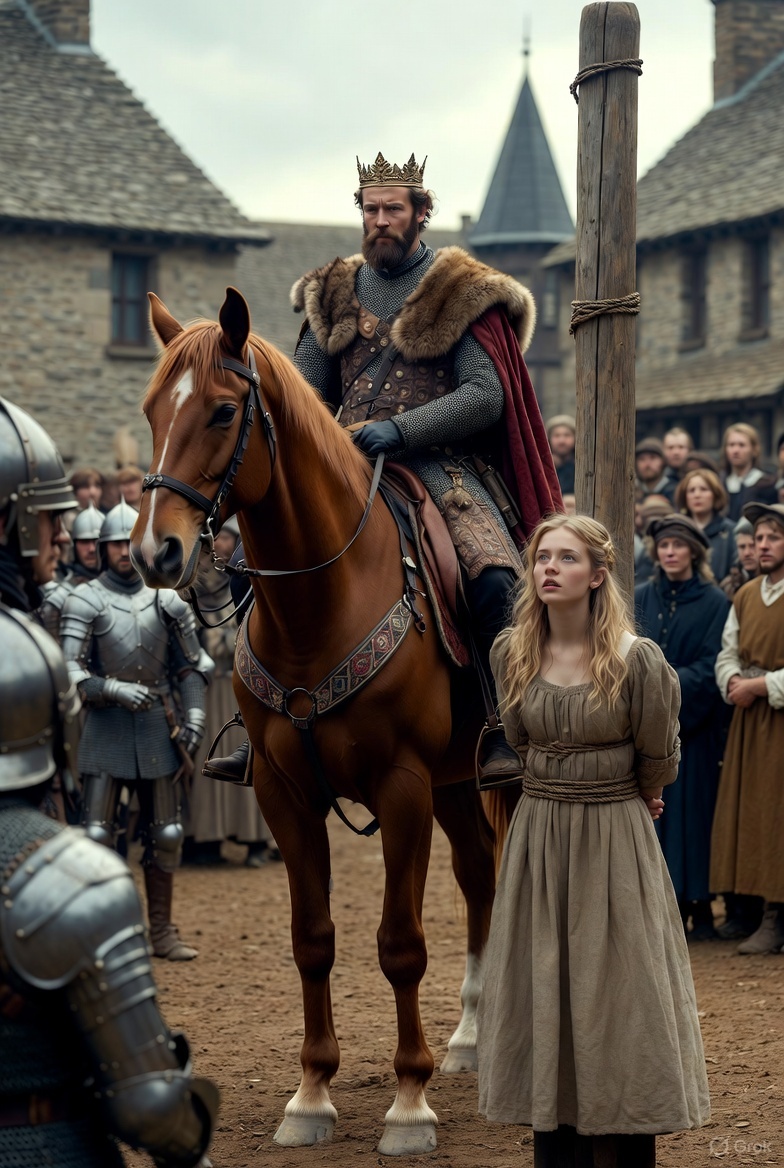
In the province of Valdris, Duke Engleton ruled from a stone keep on the hill. He was a good and kind ruler, careful of the lives under his watch. His dearest friend was a servant, Rowan, who managed the duke’s fine stables and kept his council. Rowan’s wife had died in childbirth, leaving him an infant girl. In time, alas, an accident claimed the father as well, and as he lay dying he entrusted the child to the Duke’s care. “She shall never want for anything” promised Engleton, but his friend grasped his arm with a dying effort. “I’ll not have my daughter spoiled, nor raised with a golden spoon. Protect her from a distance, and teach her to take care of herself.” This the duke swore, as his friend slipped away.
So, Duke Engleton placed the girl in a widow’s hut and taught her in secret. In the stillroom beneath the keep, by lantern light, he showed her the language of roots and leaves. Feverfew for headaches, willow bark for pain, yarrow to staunch a wound. “Plants do not lie,” he told her. “You simply must learn to read them.” Isolde was a gifted student. She learned to love the art that was her benefactor’s passion. By twelve, she could brew a draught to cool a fever or a salve to close a cut. Soon, she was exploring new herbs of her own accord, and adding to the duke’s library of handwritten research. At eighteen, the duke built a small cottage outside the town perimeter, to be her home and workshop. “Live quietly,” he said. “Heal those who need it, earn your own bread. Marry a worthy man. This is your inheritance, my promise to your father kept.”
Then came the drums of war. Engleton rode out with his banners and men-at-arms, and the province did not see him again for seven years.
In the fifth year, the Red Cough came. It began among the port hands; wet lungs, crimson flecks on linen, graves dug by moonlight. No physician could stem it. Isolde, now twenty-two, walked the villages with her basket. She brewed lung-salve from coltsfoot and honey, forced steam under blankets, pedaled hard-baked lozenges for wretched throats. Children lived who should have died. Mothers pressed copper into her palm and called her blessed.
But there was another healer in the market square. Master Galen, thick with drink and thicker with envy, a pusher of leeches and mercury, and a lover of coin. When a merchant’s son survived the night after drinking Isolde’s tea, he spat in the dust. “Luck,” he muttered. “Or pacts.”
The first whisper was soft. “She walks the woods at midnight.” True, she gathered moonbloom then, when its sap ran strongest. “Her eyes glow like a cat’s.” They were green, nothing more. But whispers breed. A child died despite her care; the father, mad with grief, was a ready ear for Galen’s treacherous tongue. “She cursed him. I watched her lips moving through the window.” Galen fanned the spark. He fear-mongered in the taverns, buying ale for the loudest and most foolish tongues. “The duke is gone! Who protects us from night-hag sorcery?” A widow, barren after three stillbirths, nodded assent. “My neighbor’s cow sickened the day Isolde passed through.” A boy claimed to have seen her dance naked in the oak grove, when in truth, he had seen her gathering bark at dawn, in a light shift, sleeves rolled and barefoot.
Soon the square filled each dusk, not with the sick, but with the furious. “Witch!” they shouted, though none could name the spell. The council, four merchants and Galen himself, met in the guildhall. They had no evidence, only volume. Petitions stacked up like cordwood. “Burn her, lest the cough return.” “Everyone knows she’s a witch.”
Isolde was seized at twilight. They bound her with the same ropes used to tether the duke’s warhorses. On the longest night of the year, they dragged her past the old cottage where her father’s saddle still hung on a peg, to the stake in the square. The pyre was built from the duke’s own yew trees, felled to widen the road in his absence. Isolde did not scream or plead. She looked at the faces she had saved, now twisted with widespread lies, and spoke only once. “It doesn’t matter…” she whispered, but her words were overpowered by the cries, “Burn her. Burn her.” They tied her to the stake. Smoke stung her eyes, pluming from hand-held torches.
Then came the horns. Not the thin bleat of town trumpets, but the deep brazen blast of war. Hooves thundered on the river road, banners snapped crimson and gold. Duke Engleton rode at the head of a column blackened by campaign dust, his armor dented, his face carved by years of iron and absence. Behind him, soldiers who had marched through foreign snows and foreign graves.
The square froze. A child dropped her torch; it hissed in a puddle of horse leavings. Engleton’s eyes swept the pyre, the ropes, the girl with soot already on her cheeks. Recognition struck him like a lance. He knew the tilt of her chin, the green of her eyes… Rowan’s eyes. His ward, his secret. His promise. He dismounted. Silence fell so complete that the river could be heard for miles. “Who ordered this?” His voice was low, menacing through gritted teeth. The merchant council opened their mouths, no sound came. Galen tried to step back, but the press of bodies trapped him where he stood. “The people,” he stammered. “The people demanded…”
“The people!” Engleton hissed. He looked around at the crowd, shame and fear creeping into their faces. Mothers who had wept when Isolde saved their sons, farmers who had recovered after inhaling her steams, all lifted fingers to point at Galen. Soldiers moved like wolves through the sheep, ready to execute Engleton’s wordless command. The crowd melted, suddenly remembering chores, children, anything but the stake, and anywhere but here. Only the council remained, herded by spear points.
Engleton climbed the platform. With his own dagger he cut Isolde’s bonds. She swayed, he caught her. Ash streaked her face but the fire had not yet been set. He wrapped his ragged campaign cloak around her, and lifted her to his own horse. He turned to face the council.
“You tried to burn my ward,” he grimaced. “My oath-child. The daughter of the man who saddled my horse for twenty years. You did this because of the tongues of many fools, mistaking noise for truth.” Galen found his voice, stepping forward. “She bewitched…” Engleton’s sword left its sheath in an instant. Galen’s head rolled into the kindling. The crowd gasped as one, watching from the doorways. The duke looked at the remaining councilors. “You followed the bandwagon over a cliff. Now, you reach bottom.”
They dropped to their knees, “Mercy, my lord…” but the executions were methodical and swift. A soldier for each councilor. A single stroke. Four bodies joined Galen’s in the dust. Isolde looked around at the shadows in the doorways. “They listened to their neighbors’ wagging tongues” she trembled. “Instead of believing their own eyes.” The Duke took the bridle and started toward the keep. “They will be the last.”
Years later, travelers passing Valdris would hear the tale; how a duke returned and slaughtered many in defense of one. They would visit the stake, left standing in memorial. On it hung a plaque, carved with the duke’s own hand.
No accusation without evidence.
No justice without trial.
No life taken because a crowd is loud.
– Duke Engleton
Under it, in a villager’s rough hand, Isolde’s would-be last words were scratched:
It doesn’t matter how many people are wrong.
– Isolde, the Oath-Child
Exodus 23:2
“Do not follow the crowd in doing wrong.”
Epictetus, Enchiridion 1
“Don’t be concerned with what the many say, but align your actions with reason. The crowd often praises what is worthless and condemns what is good.”
Call to Action
If this parable left you quietly furious at how fast a mob will burn an innocent woman to protect its own comfortable lie, then you know exactly who needs to read it. Copy the link right now.
Send it to the friend who’s afraid to speak up at work, the group chat that just piled on someone for the crime of noticing reality, the pastor who preaches “unity” while watching truth get tied to the stake. One share today could stop the next oath-child from burning tomorrow. Then come back and tell me, here or on X/Facebook, whose eyes you just opened. – D.S. Cook
Keywords / Tags
oath-child parable | burning of the oath-child | bandwagon fallacy parable | mob conformity | groupthink parable | social conformity | fear of the herd | Christian-Stoic parable | cancel culture parable | silence in the face of evil | moral cowardice | the cost of going along | persecution by consensus | tyranny of the majority | parable against peer pressure | speaking truth to the crowd | the emperor’s new clothes modern | when good men stay silent | mob burns the innocent | conformity kills | bandwagon effect dangers | parable of the silent village | Apostoic parables | D.S. Cook parable | Christian stoicism 2025
More Articles For You:
In This Way Too Shall a Day Pass: A Better Christian Stoicism – Apostoic
The Song that Killed the Village: Forced Speech in the Workplace – Apostoic
Socials:
Blog: https://growingsemistoic.wpcomstaging.com
X: @DSpencer_blog
Facebook: https://www.facebook.com/profile.php?id=61584804386705
Arm yourself for internet arguments with my free Logic Slap meme weapon: https://logic-slap.replit.app/

This blog lives entirely on reader support. If it’s worth your time, it’s worth a penny in the tip jar:


Leave a Reply