By D.S. Cook for Apostoic.com
In a barren and desolate wilderness there once dwelt three men, each fated to meet the trials appointed to mortal existence after his own fashion. The sun in that place beat down with unbendable hatred, and the footprints of wanderers with no names or records marked the trodden paths. The very land seemed a fable writ large upon the earth: pits yawned unexpectedly where one might tumble into despair, endless flats stretched onward in mocking uniformity, promising neither peril nor progress, and forbidding cliffs rose jagged to the West, unknown discoveries atop their crests.
The first of these fellows, a man of considerable intellect yet slender resolve, journeyed heedlessly through that arid expanse when, with a sudden cry and a tumble of loose stones, he plunged into a deep and shadowed pit. Its walls rose sheer and unforgiving, but round about the treacherous brink there clung certain vines, by which a man of stout heart and willing hands might yet have clambered forth. With a groan he surveyed his choices. Approaching the first vine, he stretched forth a grasping hand, only to recoil as sharp thorns pierced his palm like so many poisoned dagger tips. “This vine is altogether too thorny,” quoth he, with a terrible shudder. “I like it not; surely there must be some gentler path to deliverance.” Turning to the second, he found its surface slick and sheer, so that his fingers slipped away as though greased by fortune’s cruelest jest. “This vine is too treacherous by half,” he declared, wiping his hands with distaste. “I like it not; what manner of escape is this, that mocks the climber at every step?” At the third vine he paused longer, testing its strength, but it proved brittle and frail, cracking ominously under the slightest pressure. “Oh, you weak and fragile vine!” he exclaimed, throwing up his hands in exasperation. “I like it not; should I risk a fatal plunge for so slender a hope?” Thus did the fastidious fellow circle the pit, rejecting each prospect in turn with ever more elaborate complaints. Having completed the weary circuit again, he discovered himself once more confronting the thorny vine with which his ordeal had begun. Round and round he went, a carousel of vacillation, muttering witty protest to himself about the injustice of a world that offered only imperfect ladders to salvation.
The hours lengthened into days, and the days into a grim eternity of hunger and thirst. At length, weakened by his own meticulous paralysis, he perished miserably in the depths, a monument to the folly of those who, fearing every hardship, embrace the greatest hardship of all: doing nothing. How many souls, one might observe, have starved not from lack of bread, but from an overabundance of “I like it not”?
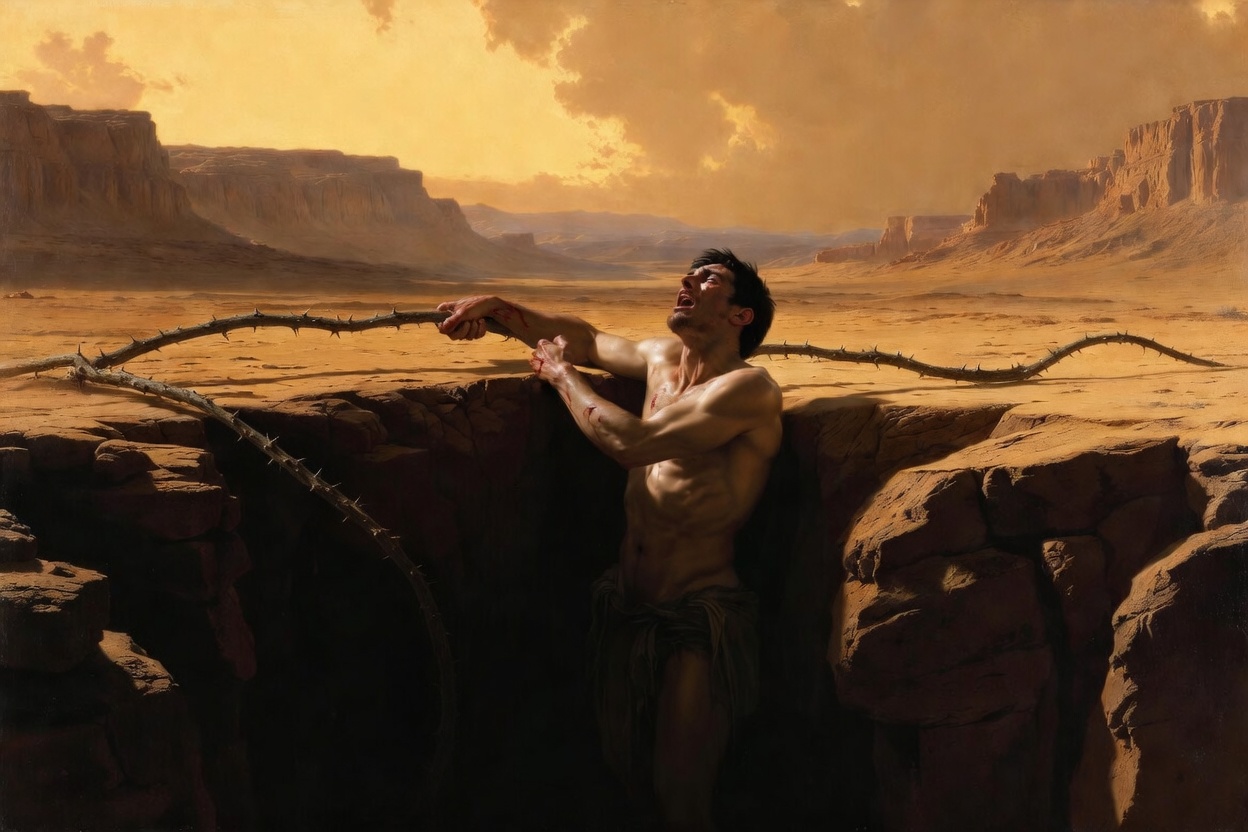
The second man met a like misfortune, tumbling into a pit of similar depth and gloom. Yet he possessed a different temper. With calm and measuring eye he examined the vines, acknowledging without illusion that each presented its peculiar trial. After but brief deliberation, he selected the thorny one, judging it stoutest and most likely to bear a man’s full weight. “Very well,” he grimly muttered, “if thorns be the price of freedom, then pierced by them shall I be free.” The ascent proved every bit as cruel as his anticipation. The barbs tore at his flesh, drawing crimson lines across his hands and arms, and more than once he nearly lost his grip amid the searing pain. Yet he pressed onward with unyielding purpose, bearing down with all his grip upon the barbs that tortured so. At last, bloodied but triumphant, he gained the upper ground, gasping beneath the open heavens.
There, having learned in the school of sore experience that he could indeed endure what was grievous and painful, he continued his journey with a visage newly hardened. Every steep cliff and rocky defile that lay before him he attacked with the same resolute spirit. It was not to escape he climbed now, but to conquer, pressing through blistering heat and howling winds until, after many toils and not a few more scars, he attained the lofty summit of the cliffs. From that grand eminence he beheld a prospect of surpassing beauty, entering at length into a place of honor, abundance, and hard-won peace. His hands, though marked with thorns, had become instruments of mastery.
As for the third man, he fell into no pit whatsoever. He trod always upon the flat and level plain of the desert, where the ground offered neither sudden chasm nor challenging ascent. His days unfolded in a monotonous ease that might have seemed enviable to the hasty observer: no grave danger threatened his steps, yet neither did any noble labor or upward striving quicken his pulse. He walked onward, season after season, complaining occasionally of the sameness of the scenery, and of a belly not empty but forever unsatisfied, while adding nothing to his own stature or to the world’s account. In the end he expired as he had lived, in quiet ignominy upon that barren expanse, leaving behind no monument, no tale of valor, and scarcely a footprint worth remembering. With a touch of mordant humor, one might say that he achieved the perfect equilibrium of mediocrity; neither drowning nor climbing, but merely drifting until the sands claimed him. His footprints mingled among those nameless and forgotten traces of those who had trod the paths before.
From these three examples, dear reader, let every thoughtful soul draw solemn and lively instruction. The paths that lead to any true betterment are, without exception, torturous and laborsome. Whether a man finds himself sunk in the sudden calamity of the pit or lingering in the sterile desert, he cannot advance one meaningful step without embracing difficulty and pain. He may, with wisdom and courage, choose his particular hardship; be it thorny, slippery, or otherwise, but he cannot escape these if he would achieve an existence worth having. To rise from the depths, or to climb from the dreary flat toward higher ground, he must be willing to take thorns into his hands, to feel the sting, and to press forward nonetheless. There is no royal road, no velvet ascent, no effortless deliverance under heaven. The comfortable man rejects every vine; the warrior seizes one and bleeds for his reward. As the noble Stoic Epictetus observed with characteristic vigor: “It is circumstances which show what men are. Therefore when a difficulty falls upon you, remember that God, like a trainer of wrestlers, has matched you with a rough young man. For what purpose? You may say. Why, that you may become an Olympic conqueror; but it is not accomplished without sweat.”
And from the sacred Scriptures we read this enduring counsel of Paul: “And not only so, but we glory in tribulations also: knowing that tribulation worketh patience; And patience, experience; and experience, hope: And hope maketh not ashamed; because the love of God is shed abroad in our hearts by the Holy Ghost which is given unto us.”
Thus ends the parable. May it prick the conscience and spur the will, that we, avoiding the fate of the first and the third men, might emulate the second; emerging from every pit and desert with thorns in our hands and glory on the horizon.