By D.S. Cook for Apostoic.com
An orchard town in the hills was famous for it’s rich harvest. Each year, the people worked together to bring in their abundant apples and carried them carefully into the storehouse against the winter cold. Every autumn, the town would choose one man to guard the building where the community kept its fruit.
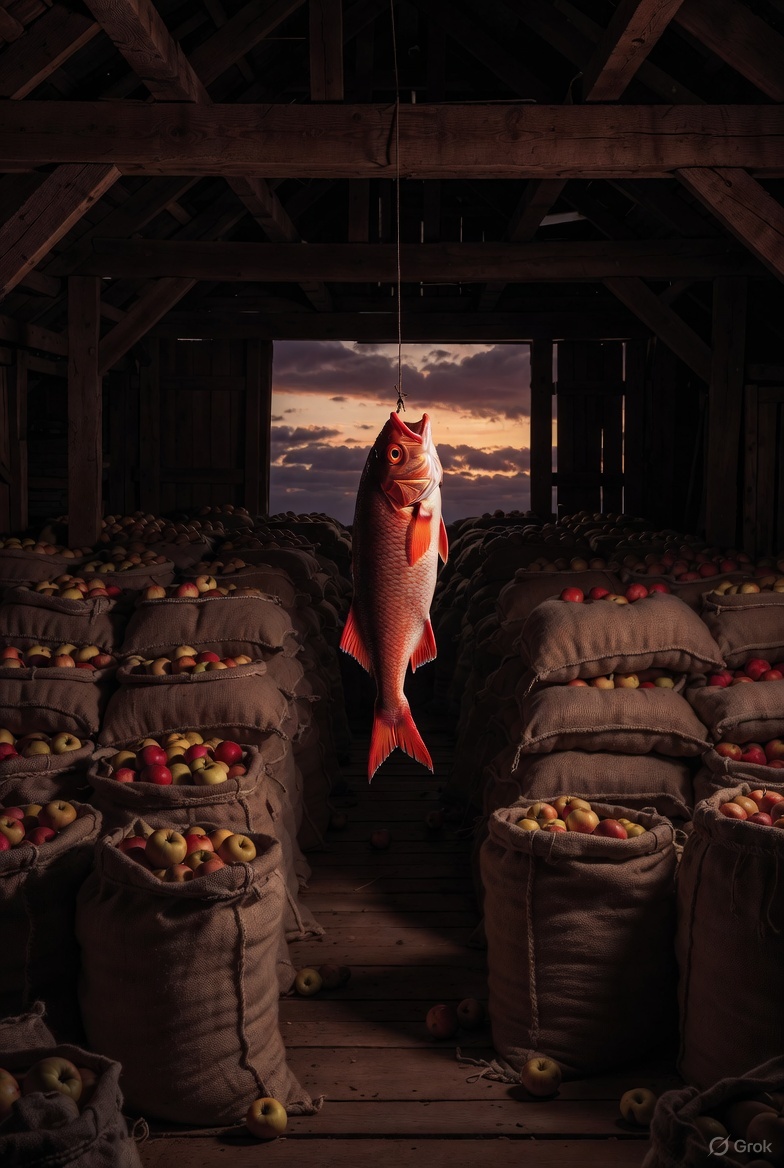
This year, the lot fell to Andrew, a man bold and strong, but foolish and brash. He took up the duty with fierce pride and slept each night inside the storehouse with his staff across his knees. One cloudy night, two boys from the village decided to play a prank. They stealthily crept to the storehouse carrying a large fish wrapped in red cloth. While one rattled the back door softly to draw Andrew’s attention, the other slipped in through the side window and hung the bright red fish from the rafters, directly above the apple sacks. Then both boys fled, taking a sack of apples each for a private feast.
At dawn, Andrew rushed into the square, waving the fish like a battle standard. “Thieves!” he roared. “Someone has broken into the storehouse!” The townsfolk gathered quickly, faces tight with alarm. Andrew thrust the fish forward. “A red herring! Proof that outsiders came in the night! Only the fishing village to the west sells these! They came to steal our apples!”
The townsfolk frowned and nodded gravely. “Those fishermen have envied our orchard for years!” Soon, the whole town was in an uproar. Men sharpened their pitchforks, women hid their children, and scouts were posted on the western road to watch. No one thought to count the sacks. No one wondered why thieves would leave such an obvious calling card.
A council was called. Andrew spoke first. “If they dared once, they’ll dare again!” He reasoned. “We must launch a preemptive raid before the thieves return in greater numbers!” All day, the town argued about the fishing folk; their odd customs, their weird dress, their discontented haggling. By nightfall war seemed the only answer.
As the sun bled out behind the hills and the men began to gather torches, a small voice rose from the crowd. It belonged to Miriam, a quiet bookworm who kept the storehouse ledger. While the town shouted, she had slipped away. She checked the tally book Andrew had forgotten, and walked the muddy floor with a lantern. She stepped forward now, the book clutched like a shield. “Forgive me,” she said timidly, voice trembling but clear. “But I think we are about to burn the wrong village.”
A low grumble rose. Andrew’s expression was condescending. “Girl, this is no time for…”
“I counted the apple sacks.” Miriam cut in. “Only two are missing. Enough for a pair of greedy boys, not a raiding party. The fishing folk would have needed wagons and men to carry off anything worth starting a war over. And look…” She pointed to the fish still dangling from Andrew’s fist. “That is our own market cloth, dyed with hill madder. The fisherfolk wrap theirs in burlap. Anyone who trades at market knows it.”
A hush fell heavier than the winter frost. Mildred the dyer stepped forward and took the fish from Andrew’s suddenly limp fingers, turned the cloth over in her hands, and nodded. “This is my cloth.” she said.
Miriam wasn’t finished. She led them to the storehouse steps and pointed to the muddy ground. “No wagon ruts. No strange boots. Just two small sets of bare feet, running out the side window and back toward the lumber yard.”
One by one the torches lowered. Pitchforks drooped like last year’s apple blossoms. Andrew’s knees buckled and he sat down hard in the dirt, his strong staff rolling from his lap.
Someone began to weep; quiet, shamed sobs that spread until half the square was crying, not from anger now but from the sudden, scalding knowledge of how close they had come to spilling innocent blood over a smelly fish and two stolen apple sacks.
The boys were found at moonrise, asleep under the carpenter’s table, bellies bulging, red dye on their fingers from the cloth they had stolen from their mother’s stall. They awoke to find every adult in the village staring down at them, not in anger, but in shame so deep it felt like mourning.
They had nearly murdered their neighbors over a prank, and the reddest thing in the village that night was not the herring, but their own faces.
Proverbs 18:13
“He that answereth a matter before he heareth it,
it is folly and shame unto him.”
Seneca, On Anger 2.26.4
“We believe whatever we are already angry about.”
Epictetus, Enchiridion 33
“Do not be dragged off by appearances.”