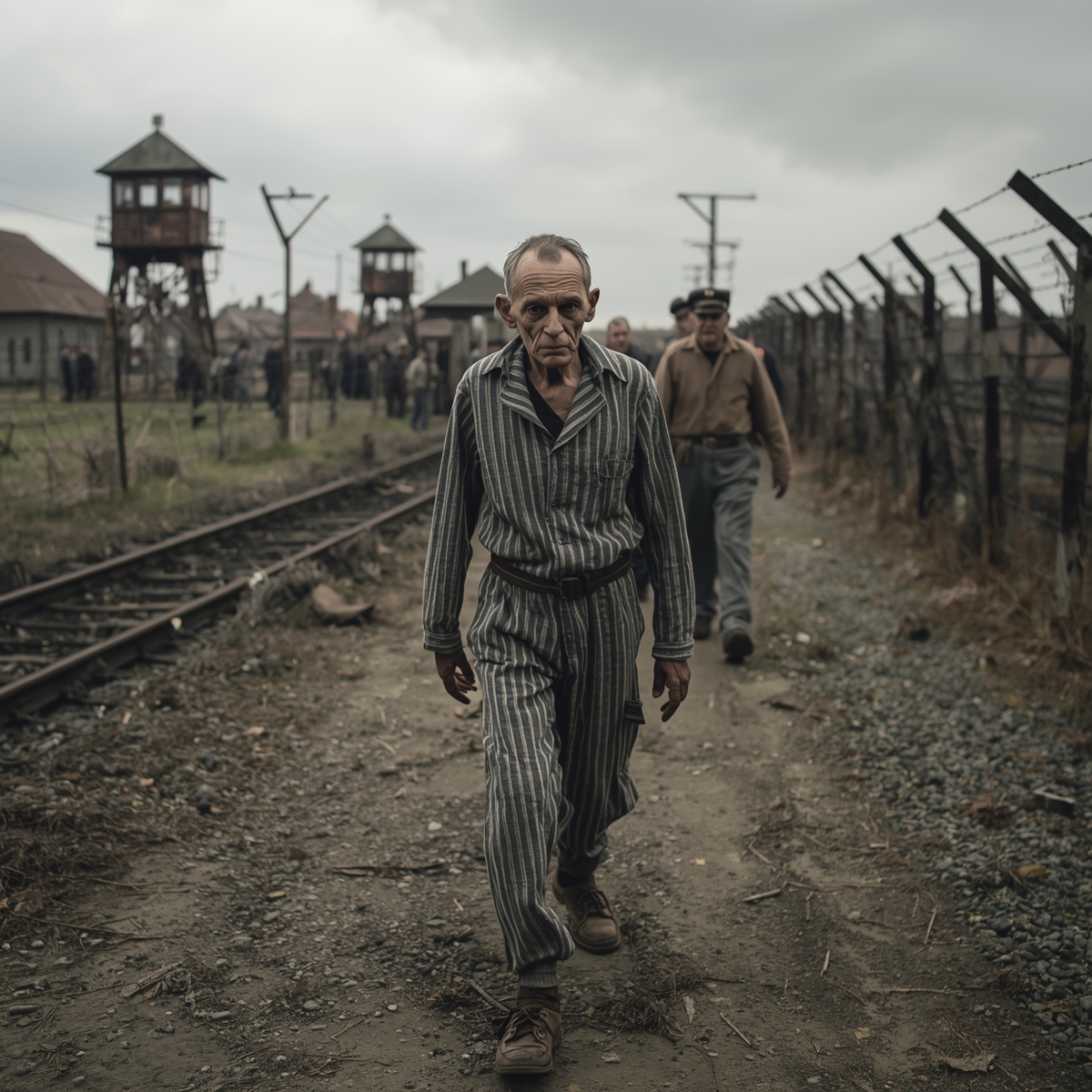
In the half-light of dawn, Viktor trudges through the frozen mud. His feet are raw with blisters from ragged shoes that do not fit, handed down from a former occupant with no more need. He shudders at the promise of the day’s forced labor. Victor has been a prisoner in the Nazi concentration camps for three years. His current home, Auschwitz, held no memorial of the turning year. It is January of 1945, four months before his liberation at the hands of allied forces. For all Victor knows, deliverance is two years away, or three. He suspects that death comes sooner.
A blow lands, but not on him. Behind him, a body falls to the earth; a bludgeon to the ribs for falling asleep while walking. Malnourishment and exhaustion resulting in a delirium, a skeleton and not a man falls to the earth, never to rise again. Yet, where despair should have long taken root, a strange litany bubbles to the surface in replacement. “This is no tragedy” murmurs Viktor. “In this way too shall a day pass.” The words rise in his chest like a breath in the cold, not as defiance, but as a fragile, stubborn hymn to endurance, a choice to wrest meaning from the jaws of suffering.
This phrase, born from my own meditations on life’s ceaseless trials and superimposed over a fictional reimagining of Viktor Frankl’s imprisonment, is no mere slogan but a chord struck across centuries. It echoes the Stoic’s unyielding resolve, as Epictetus may have whispered in his years of slavery, to bear what fate decrees with unbowed spirit. Yet it is distinct from the popular “this too shall pass” in an extremely potent aspect: Christian hope. It carries within the ancient sigh of Ecclesiastes, where all things pass under the sun’s seemingly indifferent gaze. Yet, for those who see beyond this shadow-life, like the author of that great book, it sings a quiet exultation. Each day, however heavy, hastens the believing soul toward an eternal dawn. It carries Paul’s joy in Romans 8:18, reminding that our present sufferings are not worth comparing to the glory that is to come. It triumphs in the passage of each moment, gone and never to be lived again; each an irreversible step toward the return of the King and the renewal of all that is good and right.
To the secular heart, “this too shall pass” can be a comfort, as it contains the knowledge that in one coming present this suffering will be looked back upon as the past. To the Christian heart, “in this way too shall a day pass” is so much more. It is a beacon, a lighthouse, calling to Christians awaiting redemption, reveling in the knowledge that suffering and pleasure both can make time evaporate. Where “this too shall pass” offers relief only through distance (one day this will be behind me), my phrase “in this way too shall a day pass” offers motion toward.
Toward what? In joyfully whispering this phrase to myself, I do not merely wait for suffering to end. I count each passing moment as a step closer to the great day when every tear is wiped away, when the Lamb who was slain takes up His place on the eternal throne. There is a weight to Viktor’s whisper in the mud that “this is no tragedy,” not because the horror isn’t real. God knows it is. But, because even this is folded into a larger story that ends not in annihilation, but in consummation. The day passes, yes. But it passes into something. It is not lost, it is redeemed.
In my multiple daily utterances of this phrase, I pray Paul’s words in Philippians 1: “For me, to live is Christ and to die is gain.” I hear the martyrs under the altar in Revelation 6: “How long, Sovereign Lord?”, not despairing, but waiting. Not believing, but knowing that the scroll is being unsealed, the seals are breaking, and every sunrise in Auschwitz, every sunrise in traffic, every sunrise in the chemo chair, is one less sunrise before the Son rises and never sets.
My phrase is a liturgy for the long war that is secretly a long obedience in the same direction. It is the difference between surviving and journeying. Between enduring and anticipating.
Carry it with you now.
In this way too shall a day pass.
And the Kingdom comes closer with every one.
Call to Action
If this short meditation just gave you the first calm breath you’ve taken all week, if it reminded you that even the worst day is still the same amount of progress toward the kingdom as the best one, then don’t keep that peace to yourself. Copy the link right now.
Send it to the friend who’s drowning in tomorrow’s worries, the group chat spiraling over the news, or the spouse who woke up anxious again. One quiet share can be the cool cloth on a fevered forehead. Then come tell me (here or on X/Facebook) whose day you just made bearable. — D.S. Cook
Keywords / Search Terms
Christian Stoicism | better Christian Stoicism | this too shall pass Christian | in this way too shall a day pass | Christian anxiety relief | Stoic peace with God | biblical Stoicism | daily bread meditation | one day at a time faith | Christian mindfulness | worry is imagination misused | Epictetus and Jesus | Marcus Aurelius Christian | present moment Christianity | sufficient unto the day | Matthew 6:34 Stoicism | memento mori Christian | Christian detachment | peace that surpasses understanding | Apostoic meditations | D.S. Cook Stoicism | Christian spiritual disciplines 2025 | short Christian reflections
Articles for you
The Parable of the Wandering Smith: A Christian – Stoic Tale – Apostoic
How to Control Your Thoughts: A Practical Stoic and Christian Practice Plan – Apostoic
Socials:
Blog: https://growingsemistoic.wpcomstaging.com
X: @DSpencer_blog
Facebook: https://www.facebook.com/profile.php?id=61584804386705
Arm yourself for internet arguments with my free Logic Slap meme weapon: https://logic-slap.replit.app/

This blog lives entirely on reader support. If it’s worth your time, it’s worth a penny in the tip jar:

Leave a Reply