Philosophy for the Workplace
-

For those returning from earlier installments: thanks and welcome to you. Those largely dealt with “what” we’re called to do when there’s plague in the land. Years ago, this content was framed as a letter to local pastors during COVID. My son was 7 at the time, and I believe he understood the matter better…
-

He who frames the question… Perhaps you’ve heard the adage, “He who frames the question wins the debate.” Those who fear COVID or HANTA or any other disease- they’re not just getting the wrong answers; they’re asking the wrong questions. So we need a better framework to test the worthiness of our questions. During COVID,…
-

Here we go again… Have you ever been mucking out the barn and thought to yourself, “I’ve shoveled this shi–stuff before”? I hope you’ve had that thought, because that’s where I find myself today as I’m writing this, and it might be hard for you to understand and empathize otherwise. I know I’m a month…
-

Purpose: We have encountered some Christians who object to Logic Slap, calling it unkind. Such persons insist that preaching the gospel may never employ techniques like mockery or sarcasm; these are inherently evil. Our purpose herein is not to convince others to employ our methods, but to challenge an a priori commitment, demonstrating it is…
-

An Apostoic article by guest author Terry Smith There is real wisdom in the idea of staying in your three-foot world. In moments of fear, grief, or uncertainty, the mind easily runs beyond its proper jurisdiction, dragging yesterday’s regrets into today and borrowing tomorrow’s trouble. It imagines outcomes, losses, and dangers that may never come.…
-

By D.S. Cook for Apostoic.com If you’ve stayed with this series through four installments, thank you. You’ve watched the modern concept of “respect” collapse under scrutiny. You’ve read that respect is an indifferent byproduct of the behaviors you choose, is gained in measure by those who also choose it, and lost by those who choose…
-

By D. S. Cook for Apostoic.com Welcome back to the Respect in Ruins series. This is now part three, and if you haven’t started at the beginning, I highly recommend that you pause here and do so. If you are interested in the topic of envy replacing respect, the stage must be appropriately set before…
-

By D. S. Cook for Apostoic.com Welcome back to the Respect in Ruins series. If you’re just joining us now, do me a favor and stop reading. Jump back to part 1 and start there, lest my jabbering about Nominal Conquest Fallacy, Orwellian Newspeak, and linguistic fiat make as much sense to you as a…
-

A couple years back in my old job, I tossed a simple question into our work group chat to facilitate some discussion. “What books have shaped your values into what they are today?” In rolled the usual suspects, Dale Carnegie’s How to Win Friends and Influence People, Covey’s 7 Habits; solid picks for a professional…
-

You keep lookin’ around, and none of that sh*t can help you. “My body was frozen against the rock face… ‘Hey, man,’ he said in a lazy, raspy voice. ‘Just stay in your three-foot world.’ I was a couple of hundred feet up the rock face and I could barely think, let alone decipher his…
-

When had grown young Timothe Half-shaven unto the strength of manhood, he were slight and lithe and blonde and he did sprout the fine stubble wherein young men oft take heart… upon the right half of his face only, but all the left half were silken smooth like an worn river stone, even like glass. …
-

A Story for the Covenant Christian Kids – By D.S Cook for Apostoic.com In the rolling countryside, there once lived twin brothers, Jerry and Jankerson. They were fond of one another; they played together well, shared their friends, and both were strong and healthy. One day, when they were eight, their mother said, “Boys, I…
-

By S.D. Davis for Apostoic.com People have always asked me the same question. Or more accurately, they’ve used a pretense to dismiss what matters most. “Why does logic even matter?” Among Christians the variant becomes, “Why does logic matter; since the gospel is what’s really important?” This question refutes itself. Anyone who attempts to disprove…
-
Originally written 3/17/2019 Some weeks ago, Pastor (Paul Cook) asked for a show of hands– how many had read Hosea, with about 3 responding. As a man who’d named his daughter Ruhama, I could not help but feel grieved. When he asked if any wanted to bring a teaching– well this story had formed in…
-

Long, long ago in a land far, far away there lived one Jim, an sheep herd. Now Jim was a good man, being both kindly and wise, if not much learned after the manner of scholars and mages. However, in such mean matters as the tending of beasts, the sowing of beans, or the mending…
-

By D.S. Cook for Apostoic.com An orchard town in the hills was famous for it’s rich harvest. Each year, the people worked together to bring in their abundant apples and carried them carefully into the storehouse against the winter cold. Every autumn, the town would choose one man to guard the building where the community…
-

In the thirtieth year of his reign, Emperor Liang sat upon the alabaster throne in the Hall of Balanced Scales. Two provincial governors had journeyed a thousand miles to lay their quarrel at his feet. Governor Wei of the fertile Riverlands entered first. His robes were silk, his retinue numerous, hearty, and gracious. Behind him…
-

In a certain prosperous land, a king was moved by sympathy for the poor. Knowing that not all of his subjects were charitable of their own accord, he decided to centralize and mandate kindness. He built a great Alms-House to be filled with gold. “My kingdom will provide for its neediest!” The well-meaning king declared.…
-
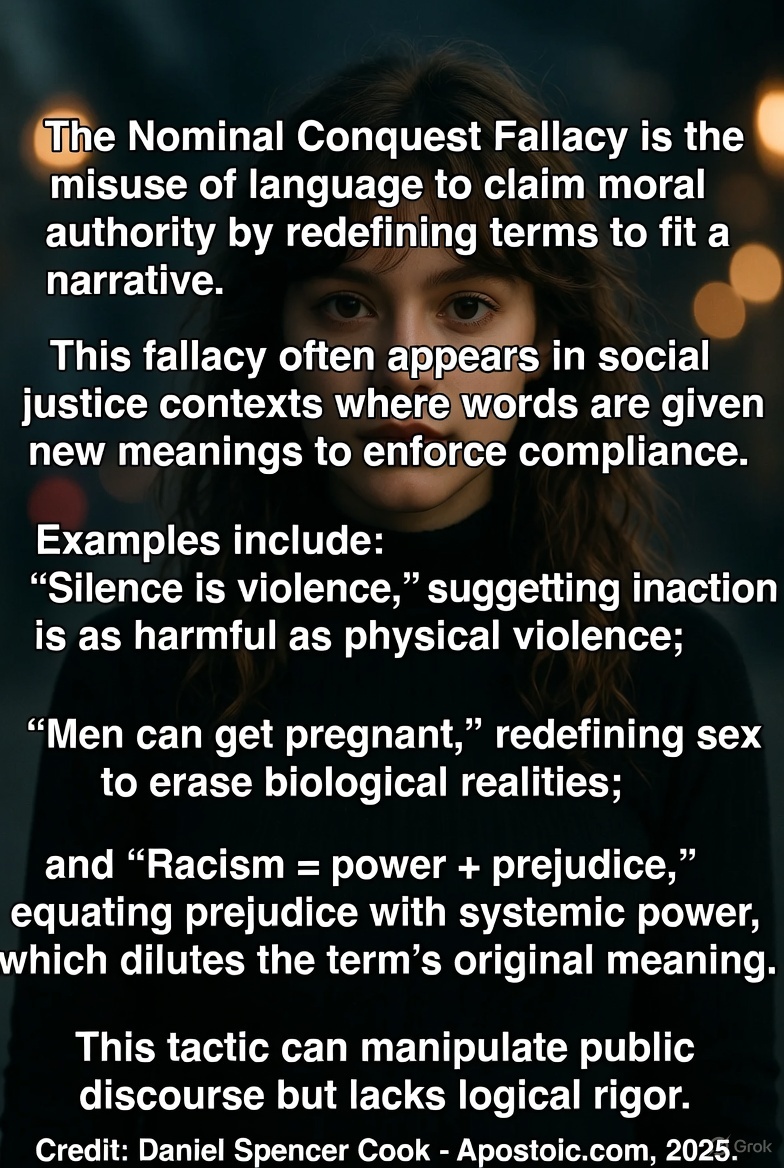
The Nominal Conquest Fallacy: Definition, Examples, and Why We Need This New Logical Fallacy in 2025
First published: 3 December 2025Canonical URL: https://growingsemistoic.wpcomstaging.com/nominal-conquest-fallacy/Author: Daniel Spencer Cook – Apostoic.com Nominal Conquest Fallacy – Formal DefinitionProposed name: Nominal Conquest (Latin nominalis “pertaining to a name” + conquestio “seizure”)Also known as: Fallacy of Nominal Conquest, Definitional Conquest, Lexical Conquest Fallacy Logical Form First Academic Definition (2025)The Nominal Conquest Fallacy occurs when an ideological movement deliberately…
-

Once on a farm next to a busy highway, there lived a pompous rooster named Squawkington, who fancied himself a great thinker and philosopher. He was famous for his loud and annoying crow, which sounded nothing at all like a rusty gate slowly murdering a stuck pig. He was also famous for his unshakeable belief…
-

In a trading village in the windy plains, Caius the blacksmith was a man of fire and iron. A handsome man with bright eyes, a charming smile, and strength born of a lifetime of physical labor, he was the envy of the village lads and ever the subject of interest for the young ladies that…
-

Elderglen’s pride was its nightly hymn. Every evening since the first stone was laid, they gathered in the square and sang the Truthsong, rooted deeply in the faith that bound them together. “We speak what is, we speak what’s real. Our voices joined, the truth we seal.” They sang of the blessings that kept them…
-

Arguments reveal more than truth, they reveal the character. Will I be arrogantly right, humbly wrong, or the inverse? Will I lose while winning, or win while losing? Here is my recent counsel to myself, offered up for your critique and possible benefit. On insignificant arguments:When certain you’re right, don’t let it show. At least…
-

As a faithful follower of Christ and a devotee to His Church, I am sometimes questioned on my appreciation for the philosophy of Stoicism, and my addition of Stoic practice to my daily pursuit of goodness, justice, truth, mercy, and temperance. These questions are generally not reproaches, but genuine curiosity as to the fitness of…
-

The Rich and The Poor It is easy for a man who has much to criticize the habits of one who has little, and easy for a poor man to criticize the wealthy for the usage of what he has. It is not common to hear the poor criticizing the poor, or the rich the…