By D.S. Cook for Apostoic Venn Blogcast.
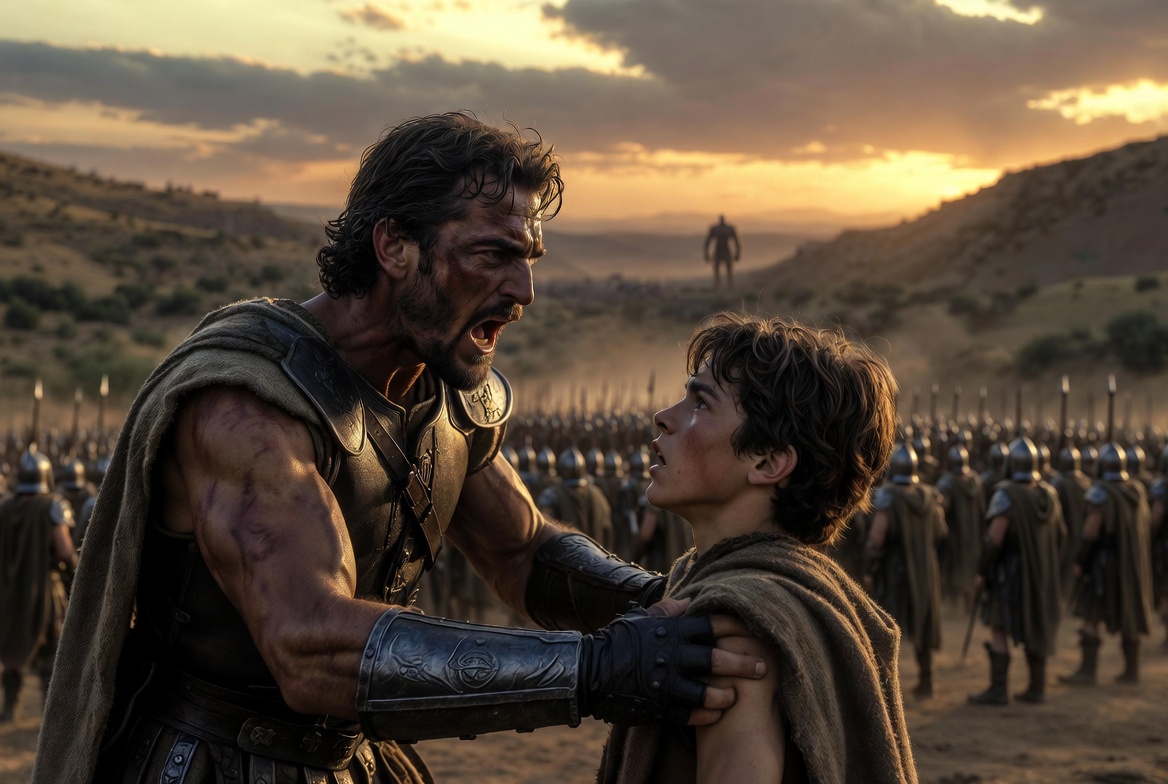
The warrior Eliab, eldest son of Jesse, stood among the trembling ranks of Israel and felt the turmoil of conflict within. Before them towered Goliath of Gath, his voice like brass, rolling like thunder across the valley of Elah, pouring forth unrestrained mockery against the Living God and his people. Mockery, and the intent to destroy. The insult burned with indignation in Eliab’s chest. His God, and that of his forefathers, the one who had led them out of slavery in Egypt by miracles of fire and water, was being mocked and reviled by pagan conquerors who worshiped blocks of carved stone and wood. Yet beneath his righteous anger lay a deeper, colder dread. The giant was invincible. Eliab could not hope to stand against him and live, nor could any other warrior he knew. The task was impossible, certain doom for any man who tried. Saul’s warriors quailed; fear and embarrassment conquering them before a single blow had fallen. And Eliab was right there with them, trembling to his core, hoping someone else would act. In forty days, no one had.
Then he saw his little brother. David, the youngest of Jesse’s sons, the shepherd not yet fully bloomed into the strength of manhood, sent only to bring provisions to Saul’s soldiers. Eliab watched him move among the men, heard him inquire about the giant, saw the fire kindle in the eyes he knew so well. When David declared his intention to fight, something within Eliab broke. The poisonous disdain of familiarity rose like gall in his throat.
He knew this boy. He had watched him bumble through childhood, awkward and impulsive. He had corrected him as a foolish teenager. He had outmatched him in strength and intellect, many times over. He remembered every past folly, every past sin, and the grand ambitions that never matched reality. How could this boy possibly believe he’d be the one to do what seasoned warriors dared not? A prophet, the Lord would later say, is never without honor except in his own country and in his own house. Though the words had not yet been spoken, they would be tested by Eliab as if tailor made. Familiarity had blinded him, and in this moment, he let it rule him.
This was no warrior. This was his little brother. An impetuous fool. A dreamer.
Eliab took him by the shoulder and shook him, his voice sharp with scorn and certainty. “Why have you come down here? And with whom did you leave those few sheep in the wilderness? I know your pride and the evil of your heart. You have come down to see the battle.”
In this, Eliab believed himself merciful and wise. He would arrest this foolish zeal before it brought shame upon the family and death upon this stripling. He would demand that David prove himself… to him, to the brothers, to the army, to the proper order of things. David must earn a place among the men. He would put a stop to this presumption, this childish bravado. David had much to prove, and he had not done so.
Yet, David did not heed him. Arrogant boy! He did not linger to defend his motives to a man whose approval he may well have craved. He did not exhaust the moment to make a case before the tribunal of fraternal familiarity. He chose instead five stones from the brook, selected for fit and utility, and gave answer not to Eliab, but to the blasphemy and threat before him. “Who is this uncircumcised Philistine, that he should defy the armies of the living God?” “The Lord who delivered me from the paw of the lion and the paw of the bear will deliver me from this man also.” His purpose was singular. He willed one thing. His zeal was for the honor of God’s name, not the small gods of brotherly approval or the admiration of the camp. He would address this reviling of that holy God, and the threat to His people, or he would die trying. Either way, he was content. The stone flew, the giant fell, and in that hour it was made plain: David had not come with something to prove. He had come with something to do.
How many of us still linger behind those same lines, facing not the giants that press upon God’s people from every side, but simpering before giants of opinion, raised by the very kindred and company to which we are bound? We carry naturally the desire to prove ourselves: to fathers, mentors, to elder siblings, to peers and patrons, to that invisible tribunal of social regard. Their esteem seems to us a worthy prize, particularly when they are indeed worthy men and women. Yet, when the hunger for their nod becomes the invisible barrier of action, we exchange liberty for bondage. Great deeds are arrested before they begin; we busy ourselves defending our motives, our intentions, and never do the thing. Young David was destined for greatness he did not know, but he started by rejecting that trade. The motivator “something to prove” can potentially turn noble labors into performances, but it is far more likely to stop them altogether.
Are you rejecting that trade? Are you turning your voice away from your critics, and toward the giant? Here at Apostoic, we engage the enemies of the living God and their demonic masters. We do battle with the giants that are too great for us; abortion, transgenderism, hedonism, sodomism, self-worship, critical race theory, atheism, communism, and many other tools wielded by the Adversary to arrest and retard the spread of Christ’s kingdom. In these confrontations, God has been with us. Gospel, scripture, and logic are being set in front of thousands of people per week. It is abundantly clear to us that our mission is from the Lord; blessed and protected by the “shield to all who trust in Him” (Psalm 18:30). We will not be deserters to the leading of our General, and abandon this battle front. Yet, on this laborious course, we have grown all too familiar with modern Eliabs from the ranks of our allies, hearing them in many forms.
“Your platform is not the approved way to defend and spread the Gospel.”
(This stone is not the approved shape.)
“Your love of ancient philosophers has no place in Christ’s kingdom.”
(The brook is not the approved source for missiles.)
“This work belongs to your betters. Get some proper credentials.”
(You don’t wear the approved armor. Come back when you’ve grown into Saul’s.)
“Your Christian-Stoic niche doesn’t pass my Biblical purity test.”
(Put away that sling. A sword is the only approved way to slay giants.)
“You address the culture too sharply. Be kinder.”
(Slaying the giant is not very nice. Offer the Philistines a cup of tea instead. Be kind to Ba’al!)
But the Church of the living God is not the International House of Nice. Jesus’ words “But I say to you who hear, love your enemies. Do good to those who hate you, bless those who curse you, pray for those who abuse you” are predicated on God’s definitions of love and goodness, and balanced with His other commands. They do not hang upon the sensibilities of 21st century megachurch youth pastors in rainbow tie-die. The same Jesus called David a man after his own heart, implying that David, in this and many other battle-ridden instances, understood and acted upon His desires. The same Jesus said “I did not come to bring peace, but a sword.” He speaks through David in inspired scripture, “It is God who arms me with strength, and makes my way perfect. He makes my feet like the feet of a deer, and sets me on my high places. He teaches my hands to make war, so that my arms can bend a bow of bronze.” “Onward, Christian soldier” we sing from our pews. David did not always march to war, but he had the discernment to tell the difference between peace-time evangelism and all out warfare with the prince of this world.
Do you have this discernment? Or, are you locked in an eternal committee meeting, far from the lines of battle, with something to prove? Hearing this may do you good. If God has given you something to do, your next right actions are not subject to the board behind the ranks, be they foe or family. Obedience to his battle call, tainted as it is with your imperfections and frailties, is righteous nonetheless. God doesn’t ask you to become sinless before you slay giants. He doesn’t ask that you fight them without offending. The Gospel we sling is a stone of stumbling, a rock of offense. (1 Peter 2:8).
The opportunistic apostle Paul did not hold council with the synagogue seats before using the tactics he used in Athens, among the Greek pagans. He would write, “For am I now seeking the approval of man, or of God?” (Galatians 1:10).
The Stoics had a significant hand in paving the way for Paul’s success in Athens. They knew of the “unknown God,” and shaped the culture that sought Him. Macus Aurelius too would shake his head at the modern Eliabs. “Waste no more time arguing what a good man should be. Be one.” (Meditations Book 10, Section 16).
Listen, then, to wise counsel. Seek the advice of those elders who have themselves crossed the battle lines, surviving and conquering by the power of Almighty God. Those whose arms have been trained by His hand to bend bows of bronze. Their scars are credentials, their experience is your armory. But when disapproval inevitably comes from those who remain behind the lines, never venturing the deeds to which God has called you, the quest for approval is misplaced. When you “will one thing,” as Kierkegaard said, and your will is to do God’s, do not let it be purloined by the purveyors of your pedigree. Turn your face from Eliab and toward the giant. Perform for the Audience of One. For in the end, only one verdict matters. “I gave you five talents, and you turned them into ten. Well done, good and faithful servant. Enter into the joy of your Lord.”
Do not be one who has something to prove. Be one who has something to do.
Key Words / Search Terms
Apostoic blog | D. S. Cook | something to prove vs something to do | David and Goliath | Eliab and David | approval seeking | fear of man | audience of one | Christian Stoicism | spiritual warfare | gospel offense | bend a bow of bronze | not seeking mans approval | doing the will of God | Christian courage | overcoming critics | faith over approval | biblical manhood | slaying giants | Christian battle | Kierkegaard will one thing | Marcus Aurelius be one
More Articles For You
When There Is Pestilence In The Land: Part 1 – Apostoic
When There Is Pestilence In The Land Part 2 – Apostoic
When There Is Pestilence In The Land Part 3 – Apostoic
Socials:
Blog: Apostoic – Christian Stoicism for a more contented life
X: @DSpencer_blog
Facebook: https://www.facebook.com/profile.php?id=61584804386705
Instagram: @apostoic
Youtube: Apostoic – YouTube
Try our Logic Slap app, a meme weapon for destroying logical fallacies in internet debates: Available on Google Play Store!


Leave a Reply