Guest Author S. D. Davis
For those who are returning, thank you and welcome back. For those who’ve found themselves in the middle of something I encourage you to read part 1 of the series first. Last week I argued that Man of Steel is correctly understood as a philosophical examination of self-control and discipline. Having presented how to understand this movie, now I’ll present why that’s the right understanding.
Some find Man of Steel hard to follow, because of its heavy reliance upon flashbacks. Imagine, for a moment, that rather than trying to relate the chronological order of a narrative that’s been retold for decades – because this is not the first time we’ve seen Zod threaten to invade earth… Imagine instead that we’re getting insight into Clark’s thought process along the way. Yes, the Zod story is unfolding, but meanwhile, each time Clark faces a challenge, he remembers the last time he had to learn the relevant discipline. What kind of movie would you have then?
Many have accused Man of Steel of being too bleak, too violent, or too conflicted to be a proper Superman story. These criticisms miss the mark as clearly as if I told you the full moon is not beautiful because the night is too black. Man of Steel is not confused about its subject; it is precise. What it offers is not a celebration of power, but an examination of restraint—an epic about self-control that unfolds in concentric circles around Clark Kent.
The tragedy of Krypton establishes the moral strata immediately. Jor-El (Clark’s biological father) explains that the Kryptonians destroyed their world by harvesting its core. Their downfall was the result of willful ignorance, driven by their catastrophic lack of self-control. They consumed without restraint, engineered life without humility, and optimized for power without regard for consequence. Krypton did not fall because they lacked strength, but because they lacked restraint. Against this backdrop, Man of Steel frames Clark’s life as a deliberate counterpoint.
The film reinforces the themes of introspection and sobriety visually. Much of Man of Steel is shot under overcast skies, with muted and desaturated colors. The world Clark inhabits is heavy, subdued, and sombre rather than exuberant. Everything about the Kryptonians, their world, and their technology is gray. Strong as steel and just as colorless. By contrast, Earth begins as a place of desaturated colors, of unfulfilled potential. Clark’s costume is the first bright, saturated image in the film paralleling the light of our sun as the source of his strength.
The first circle of self-control, Clark’s earliest discipline, is sensory and autonomic. Long before he can challenge enemies, he must first survive perception itself. As a child, Clark panics upon seeing his teacher’s beating heart and hearing distant sounds layered atop the noise of the classroom. The world intrudes unfiltered, overwhelming, relentless.
Martha Kent’s response is instructive. She does not tell Clark to suppress his gifts, nor to indulge them. She teaches him to focus. “Make the world small,” she says. “Focus on my voice…” Self-control begins here—not with strength, but with attention.
This is a profoundly stoic insight. A man who cannot govern his perceptions could never govern his actions. Clark must learn to choose that to which he attends before he can choose how he behaves. The epic begins not with heroics, but with disciplined perception. You and I will never need to filter x-ray light out of our visual spectra, but our world does daily feed us false and irrelevant information, which we must evaluate and categorize so that we can walk in the way.
In Clark’s second circle of self-control, he learns not to hurt people just because he wants to. Clark has learned to endure the world, now he must learn not to dominate it. His physical power is absolute, and that makes Him dangerous. Man of Steel understands this. Clark’s greatest threat might be, not his power, but his wrath. In his world of paper and glass, Clark can’t afford to succumb to anger anymore than he can afford to sneeze too hard. We see this discipline early. Clark saves every child on the school bus—including the one who mocked him—without hesitation or resentment.
Later, Clark is minding his own business, reading The Republic Of Plato, as though Jonathan Kent thinks the most powerful person on earth should be so “tempered as to have ordered and controlled his desires; that this man should have himself as his master.” When some children pull him away to tease him. He silently endures their jibes until his adopted father dismisses them.. But Clark’s restraint is as yet imperfect, a work-in-progress. As he stands, we see he’s crumpled a steel fence post like a beer can. “I wanted to hit that kid so bad.”
Later in life, when a passing truck driver gets handsy with a waitress, Clark rebukes him and gets a beer thrown in his face. The tough-guy shoves Clark to no avail, and Clark removes his sopping apron with thinly-veiled frustration. As the scene cuts to the outside of the restaurant, the truck driver finds his semi mysteriously impaled upon several of the logs he’d been hauling.
In both of these cases Clark avoids bodily injury, while causing property damage. While this mitigated degree of self-control is relatable to the audience, the stakes of Clark’s failures are astronomically higher than our own.
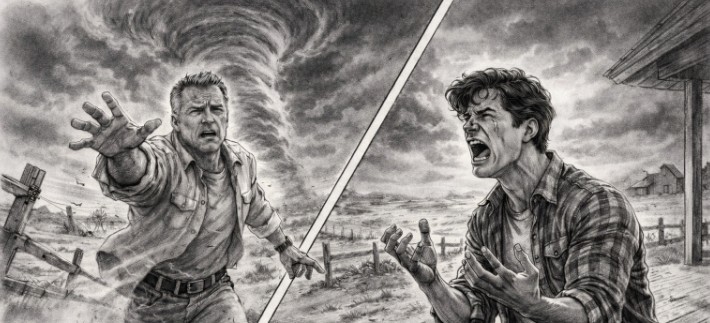
Clark frequently endures humiliation rather than retaliating. He wants to blend in, not boast. He takes transient jobs, drifts anonymously, and refuses recognition. This is not fear; it is discipline and obedience. Nowhere is this obedience clearer than Jonathan Kent’s death. Clark has the speed to save him easily. Instead, he watches his father die because Jonathan believes the world is not ready to know who Superman is. Clark submits to Jonathan’s judgment. As Lois seeks to understand Clark’s inhuman aversion to recognition, he explains “I let my father die… because I trusted him.”
Some might misunderstand this moment as weakness or passivity. It is neither. It is obedience and restraint. Clark was trusting his father’s judgment more than his own desires and impulse, even at prodigious personal cost. Clark’s anger—at injustice, at loss, at the unfairness of the moment—is brought under control by his love for his father.
More than once Jonathan Kent tells young Clark he must hide his abilities because the world isn’t ready to know and see Superman. Editor Perry White echoes this sentiment when he refuses to publish Lois’ first article about her alien rescuer. “Can you imagine how people on this planet would react if they knew there was someone like this out there?” However, I believe another, and unspoken, item on Jonathan’s mind was that Clark wasn’t ready to be seen and known as Superman. I contend that the world never became mature enough to accept Superman; Zod merely made them desperate enough to need him…
When we’ve watched Clark learn such obedience and suffering that he obeyed his father and stood by as Jonathan died– and still he was not deemed ready?– What deeper discipline awaits? What greater sufferings must he endure until he stands before humanity as a beacon of hope? Writing of Clark’s archetype the author of Hebrews says, “Though He was a Son, yet He learned obedience through what He suffered, and being made perfect, He became the author of eternal salvation to all who obey Him.”
Man of Steel is more than a demi-god discovering his strength, it’s a man being alloyed into moral readiness. Power is restrained, anger is governed, obedience is learned, and authority is delayed. Only after these disciplines are forged can Clark face his final, terrible question.
Key Words / Search Terms:
Man of Steel | Superman | self-control | restraint | discipline | Stoicism | Christian analysis | biblical wisdom | Clark Kent | Jor-El | Jonathan Kent | Krypton | self-restraint | obedience | perception | focus | anger management | humility | suffering | Hebrews obedience | Christ figure | power without restraint | Martha Kent | sensory control | endurance | Man of Steel analysis | Superman restraint | biblical self-control | stoic insights | Christian perspective Superman | Kryptonian downfall | moral readiness | Apostoic | Stoic Christian
More Articles For You:
A Christian Analysis of Stoicism and Self-Control in Man of Steel: Superman’s Restraint and Biblical Wisdom – Part 1 – Apostoic
The Emperor and the Two Governors: A Christian – Stoic Parable of Sequence and Causation – Apostoic
S.D. Davis Socials
Facebook:
https://www.facebook.com/profile.php?id=100011203688273&comment_id=Y29tbWVudDoxMjIxMTc1NjExNjMxNjAxNDZfOTAzNDc1MzM1ODgyNjY5
Linkedin:
https://www.linkedin.com/in/samuel-davis-hwial/
Apostoic Socials:
Blog: https://apostoic.com
X: @DSpencer_blog
Facebook: https://www.facebook.com/profile.php?id=61584804386705
Instagram: @apostoic
This blog lives entirely on reader support. If it’s worth your time, it’s worth a penny in the tip jar. All proceeds to go ad campaigns to spread these articles across the net.

Leave a Reply to A Christian Analysis of Stoicism and Self-Control in Man of Steel: Superman’s Restraint and Biblical Wisdom – Part 3 – ApostoicCancel reply