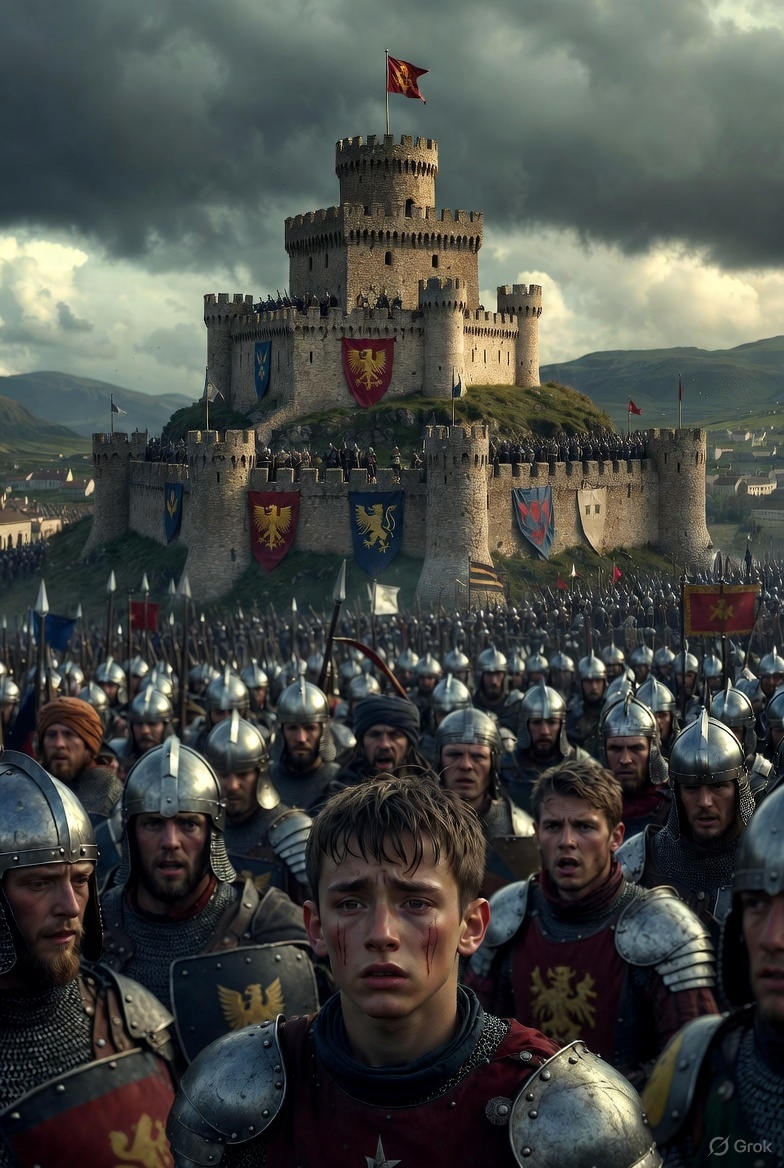
In a vast and ancient kingdom, there once stood a strong fortress, perched high upon a hill. Its towering stone walls were a steadfast guardian over the valleys below, it’s principled governance and dignified generosity sheltered the poor and the sojourner for generations. But the wise and beloved king, whose words and deeds inspired songs of loyalty and gratitude, was on a long absence. The people within its walls were his devoted followers, united by a common vow to preserve his heritage against any threat, until his return.
But over time, they divided into proud clans, each expressing their devotion to the king in distinct ways. The Eagle clan etched a golden eagle on their shields, proclaiming it the perfect symbol of the king’s soaring vision and unerring justice. The Lion Clan displayed a roaring silver lion on their bucklers, arguing that it embodied his fierce protection and sovereign power. Not to be outdone, the Rose Clan wove crimson roses into their banners, insisting that this beautiful bloom best represented his tender, sacrificial heart. As time went on, even smaller factions broke off, each following their own emblems and rites, each fiercely guarding what they believed was the truest path to honor him.
In peaceful seasons, these differences fueled earnest discussions by flickering hearths and in echoing lecture halls. Debates often grew heated, for they were borne of passion and tradition, and a desire to serve the king perfectly. Families passed down their stories of these traditions, and the factions grew in number and in distance from one another.
Then, one stormy evening, scouts stumbled through the gates, faces pale and clothing torn. “An immense army approaches!” they cried. “They are no mere rivals, they are utter enemies of the king. They curse his name, shatter his images, and swear to obliterate his kingdom from the earth, together with all who follow him!” As the months passed, the reports grew more dire. The invaders had already overrun distant cities, and claimed the golden fields that supplied the fortress. They fouled the sparkling rivers and wells, far upstream. In the conquered towns, they silenced the school lessons of the king’s wisdom, filling young minds with lies that exalted cruelty over kindness. Theaters and plays, once alive with tales of heroism and hope, now pedaled mockery and despair. The very soul of the land; the stories, songs, and values that shaped its people, were falling into bondage to a great foreign crusade.
A few hearts pounded in the council chambers. A few voices rose urgently: “We must stand as one! Lay aside our disputes and man the walls! We must sally forth as one unit and take back our kingdom, before it is too late!” Tears welled in the eyes of mothers clutching children, pleading for unity among men who loved to sharpen their wits against one another.
Yet others hardened. “Not yet,” they declared, voices trembling with conviction. “Our differences strike at the very heart of loyalty. How can we fight alongside those who bear false emblems, who dilute the king’s honor with strange practices in his name!” The arguments intensified. Old comrades turned suspicious glances. In shadowed alleys, clashes erupted between shields bearing eagle and lion, and roses on banners lifted high against both. Blood stained the cobblestones, spilt not by invaders, but by brothers. A father disowned his son over a disputed ritual, a widow mourned her husband, felled in an inner fray while enemy fires glowed on the horizon, now in plain sight.
As a siege began in earnest, and hunger and thirst began to gnaw, one young warrior knelt weeping amid the chaos. “Are we so blind?” He cried with a loud voice. “The true foe hammers on our gates while we tear ourselves apart!” But the reply drowned his voice, lifted from every corner of the streets. “Truth before survival! Unity without purity is no better than surrender.” The weeping warrior, eyes downcast but determined, gathered a few friends and rode out to meet the enemy on the field. There he fell nearly alone, an arrow through his neck.
Finally, with a thunderous crack that shattered the night, the great gates gave way. The horde surged in, merciless, exultant. The defenders, weary and fractured, fought valiantly in pockets, but could not hold. One by one they fell, brave souls whose strength, if joined, might have repelled the enemy and saved the land. Smoke billowed over the fallen fortress as survivors fled into exile, carrying the ashes of regret and shame. In hushed tones in the caves and sewers, they told their children of the home that need not have been lost, of walls that could have endured, hearts that could have beaten as one against the darkness.
The kingdom grieved, broken over the loss of what might have stood unbroken, had the clans remembered that they served the same king against a common foe.
Finally, in his appointed time, the king himself did return, with a sweeping and unstoppable army that no enemy could resist. As he reclaimed his kingdom and banished the wickedness that had enslaved it, he paused at the unmarked grave of the weeping warrior. On this mound, and this alone, did he erect a stone. It bore two words only. “Well done.”
A Call to Action: Be the Weeping Warrior
Brothers and sisters in Christ,
You have just read the Parable of the Besieged Fortress. If it stirred something in you, if it brought a lump to your throat or a heaviness to your chest, do not let it fade quietly into the noise of another day. The fortress is not a fairy tale. It is us. Now. While we sharpen our words against one another over emblems that all pale before the Cross, yelling “I am of Catholic,” “I am of Baptist,” “I am of Anglican,” the enemies of our King have taken the gates of our culture. They shape the minds of our children in classrooms, the desires of our neighbors through screens, the very stories our society tells itself about truth, goodness, and beauty. They do not merely disagree with us; they hate our Lord and seek to erase His name from the earth. And we, His professed followers, stand in the courtyard, shields raised against brothers and sisters on the internet who name the same Savior, while the true foe laughs beyond the walls.
There was one in the parable who saw clearly. A young warrior who knelt weeping amid the chaos, who cried out against the madness, who gathered a few friends and rode out to meet the enemy even when no one followed. He fell nearly alone. Yet when the King Himself returned, He paused at one grave alone and spoke two words that echo through eternity: “Well done.”
I am tired of standing in the courtyard. I choose to be the weeping warrior. Not because I am braver or wiser or more learned than anyone else, God knows I am not. But because silence in this hour feels like consent to the ruin of all we claim to love. Will you stand with me? Not by abandoning conviction. Not by pretending theology does not matter. But by refusing to let those differences become the blade with which we wound the Body while the wolves devour the sheep. Share this parable. Send it to your pastor, your small group, your friend across the theological divide. Post it where others will see it. Let it travel farther than our comfortable circles. Let it reach the ones who need to hear that the hour is later than we think. Let us turn, shoulder to shoulder… Eagle, Lion, Rose, and every smaller banner besides… and face the common foe while there is yet time. The King is coming. May He find us not scattered in inner strife, but faithful at the wall, having spent ourselves for His kingdom and for one another.
Be the weeping warrior.
The fortress is burning.
There is no time left for anything less.
In the name of the returning King,
D. S. Cook
Key Words / Search Terms Christian unity | Christian division | ecumenism | intra-Christian conflict | Protestant Catholic divide | Calvinist Arminian debate | church infighting | cultural decay Christianity | secularism rise | enemies of Christ | Islam threat Christianity | Wokeness Christianity | woke ideology | Islamic advance West | besieged fortress parable | weeping warrior | Christian parable | appeal for unity | return of Christ | King returning parable | theological disputes | online Christian arguments | Body of Christ wounded | wolves devour sheep | fortress burning
Socials:
Blog: https://growingsemistoic.wpcomstaging.com
X: @DSpencer_blog
Facebook: https://www.facebook.com/profile.php?id=61584804386705
Instagram: @apostoic
This blog lives entirely on reader support. If it’s worth your time, it’s worth a penny in the tip jar. All proceeds to go ad campaigns to spread these articles across the net.

Leave a Reply