If you’ve found your way here without reading the previous parts, your presence is most welcome, but in the interest of forestalling your confusion I recommend beginning at the beginning. You’ll find a link at the bottom of the page. To those of you returning from part three, welcome back.
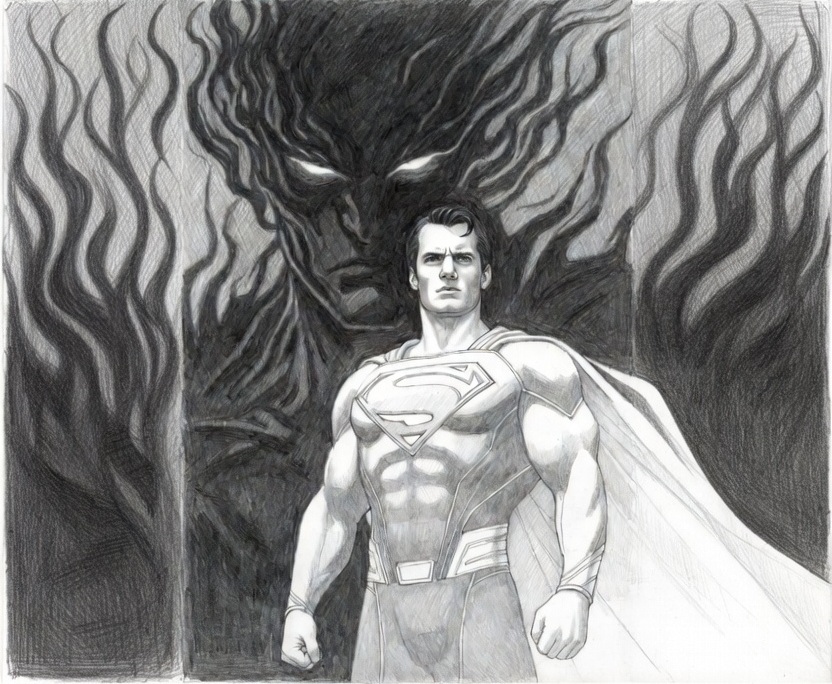
Having explored Superman’s concentric circles of restraint in Man of Steel, we’ll now contrast it with Thunderbolts‘ Bob Reynolds, a man of god-like power without a moral compass. Man of Steel asks: What if a man of unimaginable strength also possesses an equally potent regard for the sanctity of life and sense of self-control? Thunderbolts asks the opposite question: What if a manic-depressive meth addict gains unimaginable strength? Man of Steel envisions great power ordered toward moral good. Thunderbolts displays power in the hands of a fractured soul. One shows the cure for our cultural malaise; the other merely diagnoses and echoes that ailment.
For those who’ve not seen Thunderbolts, Bob Reynolds was abused by his father and is socially dysfunctional as an adult. He eventually lands himself in a gutter in Southeast Asia coming down off a meth trip. It’s at this time that he finds his way into a “medical trial” which is actually a guinea-pig program for an American super-soldier project.
Valentina DeFontaine owns a para-military organization conducting these experiments which eventually turn Bob into the Sentry. Sentry is a veneer of glory and power: golden uniform, blonde hair, speed, strength, flight, and invulnerability. But Bob’s undisciplined, schizophrenic mind manifests all that power into an alter-ego: the Void.
Void appears pitch-black without any texture or detail. While the extent of his powers isn’t perfectly clear, he seems less a physical being and more a projection from Bob’s mind into our world. Besides seeming immunity to all physical assaults, Void can spread his darkness to consume things around him. People who fall into the Void disappear from our world to find themselves forever reliving their deepest shames and regrets within the psychic space from which Void is native.
We need perfect people to guide us. We also need broken people to warn us. We need fixed points from which we can take our bearings as we try to be all that we’re called to be in Christ. Some struggle toward virtue despite their flaws; others abandon the struggle entirely. The first reminds us what our imperfect efforts will look like. The second reminds us what not to become.
Soren Kierkegaard wrote, “Purity of heart is to will one thing.” While he’s blatantly borrowing Jesus’ words from Matthew 6 “no man can serve two masters…” somehow this line of Kierkegaard’s has echoed in my brain since I first encountered it in the book Desiring God almost 20 years ago. The Stoic Seneca echoes this idea, writing “Let all your efforts be directed to something, let them keep that end in view.”
I need not revisit all my arguments that Man of Steel is a story of a man who singularly wills to preserve innocent life. But I must state that Zod and Faora possess a singleness of purpose toward the survival of Krypton which lends a kind of tragic grandeur to the villains of Man of Steel far surpassing even the “heroes” of Thunderbolts.
Bob Reynolds is a man divided against himself, and therefore he cannot stand. His mind is less like a throne directing great power and more like a battlefield where two armies contend for the same weapon. Bob says, “I have these good days, where I feel invincible. But there are a lot of bad days where I remember that nothing matters.” Yelena replies, “So you’re just going to sit here and let it [Void] take over.” Bob ends, “No use in fighting it.” Bob’s division finds its ultimate expression in the golden Sentry and the dark Void. Part of Bob’s mind desires power to respond to his father’s abuses and the recognition he’d never received. The other part cowers before the echoes of those abuses, believing that nothing matters and life is only increasing pain. Just as he tells Yelena, “There’s no death here [in the Void], the pain only gets worse.”
In part one, we talked about Nietzsche and his inadvertent influence upon Nazi ideology. Nietzsche’s philosophy was a void, and it bore monsters. And in what is perhaps his most quoted line, Nietzsche warns against being consistent with his own philosophy. “Beware that, when fighting monsters, you yourself do not become a monster. For when you gaze long into the void. The void gazes also into you.” Nietzsche’s ubermench would read and believe his philosophy, while doing something else entirely. “God is dead; and morality cannot be measured. Therefore I will be righteous and self-controlled.”
Marvel’s Void is a picture of Nietzschean consistency. Void’s idea of helping is completely disjointed from real ideas about good and evil. Void’s very first line in Thunderbolts is to a man shooting at him, “Aren’t you tired of fighting? Let me help you.” Void “helped”, by dropping the shooter out of reality into a world of recursive personal shadows, regrets, and nightmares. Killing Zod was Clark’s last great test at the extremity of need. For Void, killing multitudes, nay worse, condemning them to the eternal darkness of their own fractured minds is his first response.
As Valentina justifies turning Bob into the mighty Sentry; her words– the very words which birthed Void– echo Nietzsche’s abyss of monsters, “Righteousness without power is just an opinion. There is no good guy, just a bad guy and worse guy.” In Man of Steel, Faora-Ul said virtually the same thing, “You are weak, son of El. The fact that you possess a sense of morality, and we do not, gives us an evolutionary advantage. And if history teaches us anything, it is that evolution always wins.”
When Void takes over Bob’s body, Bob turtles himself into what he calls the “nicest” corner of his own memories to watch his father abuse him and his mother ad infinitum. The darkest corner of Bob’s mind is the memory of the laboratory room in Southeast Asia where Void was born and claimed his first victims. Bob finally starts to “win” his battle with Void, with shades and whispers of ebony blood spattering the concrete floor. But this isn’t really victory, even as he punches Void in the face, Void is consuming him from the ground up. By giving in to rage, the last, fragile piece that might still be called Bob is feeding himself to Void. Bob was unequal to the kind of measured execution which Clark performed upon Zod, and was only rescued by his friends at the last moment.
Thunderbolts presents Bob to us as an abject failure, a tragic anti-hero. Bob’s battle with his own mind is the film’s greatest conflict, and he indisputably loses. Bob is rescued, then he retreats, then he cowers from his conflict. And Thunderbolts just leaves the audience on this note. Bob can’t use the Sentry’s power without giving in to rage or despair and waking Void. “Sorry guys… I can’t be the Sentry without the… other side. I did the dishes, though!”
Since Man of Steel excels in thematic depth and moral coherence, we must ask why Thunderbolts fared better both critically and with the broader audience. Why? I contend that our culture has forgotten how to watch a film like Man of Steel, which doesn’t make it any less grand. By contrast, Thunderbolts was an echo chamber for our socio-political moment. “Daddy, I’m so alone. I don’t have anything anymore. All I do is sit and look at my phone, and think of all the terrible things that I’ve done; and then I go to work, and then I drink, come home to no-one, and I sit and think about all the terrible things I’ve done again and again and I go crazy!”
Thunderbolts resonates by mirroring cultural isolation and despair unflinchingly—earning acclaim for its honesty—while Man of Steel‘s call to disciplined aspiration feels almost alien today.
Thunderbolts diagnosed our malaise, but Man of Steel gave the cure. Thunderbolts shows us what a fractured soul looks like when it gains power. Man of Steel shows us what power looks like when it is governed by a unified soul. One reflects our cultural despair back to us. The other calls us to something better. Jor-El spoke to Clark Kent, “You will give the people of Earth an ideal to strive towards. They will race behind you, they will stumble, they will fall. But in time, they will join you in the sun, Kal. In time, you will help them accomplish wonders.”
Thunderbolts quotes half of a famous line by Kierkegaard, “Life can only be understood backwards…” The film leaves the rest unsaid, “…but it must be lived forward.” Within context Kierkegaard continues to meditate upon the importance and apparent impossibility of living retrospectively. Which begs the question, “How can we then properly understand life while we are still living it, so that we can live it meaningfully?” This requires a perspective from outside time and life, so that we can look back on life and make sense of it. That exterior perspective is entirely absent from Thunderbolts. Man of Steel offers us Krypton as what not to become and Superman as what to strive toward. God in His grace has given us Himself as a beacon of purpose and perspective so that we can understand how to live well, while there is still life left to live.
S. D. Davis
Man of Steel analysis | Superman self-control | Man of Steel Christian perspective | Thunderbolts Sentry Void comparison | Superman restraint vs Sentry | Christian Stoicism superheroes | Man of Steel vs Thunderbolts | self-control in Superman | Nietzsche Void philosophy | Kierkegaard in Thunderbolts | Superman moral restraint | fractured soul power | cultural malaise superheroes | Jor-El ideal strive | disciplined aspiration vs despair | biblical wisdom Man of Steel | Thunderbolts 2025 review Christian | Superman as beacon of hope | power without morality | Sentry Bob Reynolds analysis
More Articles for You:
A Christian Analysis of Stoicism and Self-Control in Man of Steel: Superman’s Restraint and Biblical Wisdom – Part 1 – Apostoic
A Christian Analysis of Stoicism and Self-Control in Man of Steel: Superman’s Restraint and Biblical Wisdom – Part 2 – Apostoic
Apostoic Socials:
Blog: https://apostoic.com
X: @DSpencer_blog
Facebook: https://www.facebook.com/profile.php?id=61584804386705
Instagram: @apostoic
This blog lives entirely on reader support. If it’s worth your time, it’s worth a penny in the tip jar. All proceeds to go ad campaigns to spread these articles across the net.

Leave a Reply