Guest Author S.D. Davis
For those of you who are returning, welcome back. I’m delighted I’ve held your interest into this third installment. For those arriving here for the first time, you are just as welcome, but I do encourage you to read parts 1 and 2 first.
In part 2, we left off our consideration of Clark’s concentric circles of developing self-control. In the first circle, he learned enough discipline to master his senses and power. In the second circle, he learned enough discipline to obey his father, even to the point of watching him die.
In Clark’s third circle of self-control, he learns not to show anger, even when enduring indignity and threat to his own life. While the world hadn’t become ready for Clark, they needed him, so he became ready for them. During one of the most important scenes of the film, Clark consults a priest regarding Zod’s surrender ultimatum. Throughout this pivotal conversation the camera perspective and shot-framing tells the real story. From the priest’s perspective, we see Clark in the foreground with a stained-glass window of Christ in Gethsemane in the background. From Clark’s perspective, the priest is in the foreground with the Cross of Calvary in the background. Clark is deciding whether to give his life for the world, exactly the same matter Christ considered in Gethsemane. Clark even tells a doctor later that he is thirty-three years old— the age traditionally ascribed to Christ at His death.
Clark is never the same after consulting the priest; afterward he embodies an extraordinary serenity against the rest of the problems which come his way. We never see his anger get the better of him again. And I can’t help but recall, “When the days drew near for [Jesus] to be taken up, He set His face to go to Jerusalem.”
Clark surrenders himself to humanity. He endures handcuffs. He submits to interrogation. He allows himself to be treated as a threat. He does not fight back. More than this, he allows humanity to hand him over to Zod so they can claim compliance on the off chance that Zod will keep his word and not harm them. “As a lamb before its shearers is silent, so He opened not his mouth.” In this third circle, Clark learned the discipline to lay down his own life.
Nevertheless, the greatest act of self-control in Man of Steel is also the most controversial. In Clark’s last and most terrible circle of self-control, he must learn how and when to take life. Clark’s entire existence has been ordered toward restraint, so that he can avoid causing harm. He has endured injury and indignity. He has refused dominance. And now, at the climax, he is forced into a moment where passive self-restraint will not suffice, and active, measured, martial control takes its most grievous form.
Zod is the nightmare opposite of Clark. In the span of hours, he learns to master his new senses, his strength, even flight and heat-vision. Zod exemplifies all the visceral circles of discipline, with none of Clark’s moral restraint. “I exist only to protect Krypton. That is the sole purpose for which I was born. And every action I take no matter how violent or how cruel is for the greater good of my people. And now I have no people. My soul, that is what you have taken from me.” Zod says further, “I was bred to be a warrior, Kal. Trained my entire life to master my senses. Where did you train? On a farm?”
Faora-Ul declares that Clark’s morality is his weakness. “You are weak, son of El. The fact that you possess a sense of morality, and we do not, gives us an evolutionary advantage. And if history teaches us anything, it is that evolution always wins.”
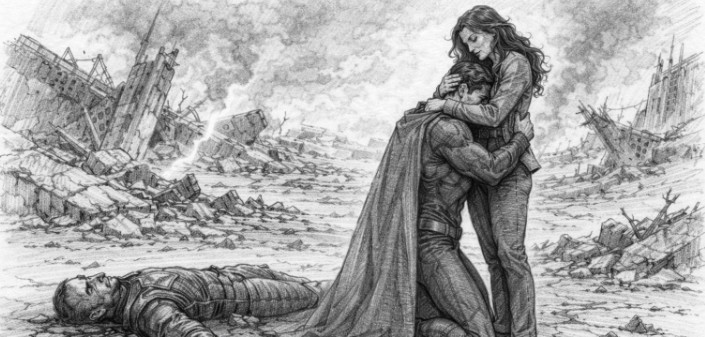
Clark does not kill impulsively. He restrains Zod. He begs him to stop. He pleads for submission. Only when Zod continues to threaten innocent lives—only when all other restraint fails—does Clark act. The killing is not triumphant. Clark’s scream is anguished, not victorious. This is not indulgence in violence; it is the acceptance of moral burden. He sees the hands which were supposed to be the hope of the world tainted with blood. Clark does not abandon his discipline. He completes it. And that brutal, haunting scream… the torture in Clark’s face… every time I see it, hear it, I remember Christ’s cry of dereliction, “My God, My God Why have You forsaken Me?” Becoming the savior, the leader, Jonathan meant him to be… implementing all the life-long lessons of discipline and the sanctity of life, even when that life is weak…meant Clark must kill for the first time, and that death must be his last, living kinsman. Zod knew he couldn’t win. The last, greatest wound he could inflict on Kal was forcing him to choose: act and take Zod’s wicked life or do nothing and watch innocent humans die.
Epictetus wrote in The Discourses Book 1, Chapter 2: “How then shall every man among us perceive what is suitable to his character? How does the bull alone, when the lion has attacked, discover his own powers and put himself forward in defense of the whole herd? It is plain that with the powers the perception of having them is immediately conjoined; and, therefore, whoever of us has such powers will not be ignorant of them. Now a bull is not made suddenly, nor a brave man; but we must discipline ourselves in the winter for the summer campaign, and not rashly run upon that which does not concern us. Only consider at what price you sell your own will; if for no other reason, at least for this, that you sell it not for a small sum.”
As we consider again, the concentric circles of Clark’s self-control, we find that first he needed enough discipline to live. Second, he needed enough discipline to watch his father die. Third, he needed enough discipline to offer up his own life. Finally, he needed enough discipline to take a wicked life. Clark sold his will, his innocence at great cost. He bought innocent lives.
Self-control is not the absence of action. It is the determination to act rightly, even when the cost feels unbearable. Man of Steel does not glorify destruction. It mourns it. It teaches that power without restraint destroys worlds, and that true strength is measured by the ability to govern oneself for the sake of others.In an age that confuses impulse with authenticity and power with entitlement, Man of Steel offers something older and sterner: a vision of self-control that begins inward, expands outward, and culminates in moral responsibility. In a franchise spanning many decades and hundreds of authors, we’re bound to find variance, even within the canon. Some writers understood better, and some worse, but self-control is Superman’s greatest power. Because Man of Steel tells this tale of restraint better than any other adaptation I’ve ever seen, I propose it is the greatest Superman story yet told.
Key Words / Search Terms
Man of Steel | Superman self-control | Clark Kent restraint | Superman kills Zod | Man of Steel Zod death | Superman restraint | Clark Kent priest scene | Man of Steel church scene | Superman Christ figure | Man of Steel Gethsemane | Clark Kent Gethsemane | Superman thirty-three years old | Christ in Gethsemane stained glass | Superman as lamb to slaughter | Jesus cry of dereliction | Superman sacrifice | Biblical self-control Superman | Stoicism self-control | Epictetus Discourses | Epictetus bull lion | Stoic restraint Superman | Self-control concentric circles | Discipline moral burden | Power without restraint | Selling your will Epictetus | Zod vs Clark | Faora morality weakness | Kryptonian warrior discipline | Evolutionary advantage morality | Moral responsibility Superman | Christian analysis Man of Steel | Biblical wisdom Superman | Stoicism and Christianity | Self-control biblical | Superman greatest power restraint | Man of Steel greatest Superman story | Apostolic Superman series | Concentric circles self-control | Restraint moral action | Man of Steel priest surrender ultimatum | Clark Kent stained glass Christ | Superman anguished scream Zod | Superman lays down life | Zod forces Superman to kill | Self-control take life | Superman serenity after priest | Apostoic
More Articles for You:
A Christian Analysis of Stoicism and Self-Control in Man of Steel: Superman’s Restraint and Biblical Wisdom – Part 1 – Apostoic
A Christian Analysis of Stoicism and Self-Control in Man of Steel: Superman’s Restraint and Biblical Wisdom – Part 2 – Apostoic
S.D. Davis Socials
Facebook:
https://www.facebook.com/profile.php?id=100011203688273&comment_id=Y29tbWVudDoxMjIxMTc1NjExNjMxNjAxNDZfOTAzNDc1MzM1ODgyNjY5
Linkedin:
https://www.linkedin.com/in/samuel-davis-hwial/
Apostoic Socials:
Blog: https://apostoic.com
X: @DSpencer_blog
Facebook: https://www.facebook.com/profile.php?id=61584804386705
Instagram: @apostoic
This blog lives entirely on reader support. If it’s worth your time, it’s worth a penny in the tip jar. All proceeds to go ad campaigns to spread these articles across the net.

Leave a Reply