Guest Author: S. D. Davis
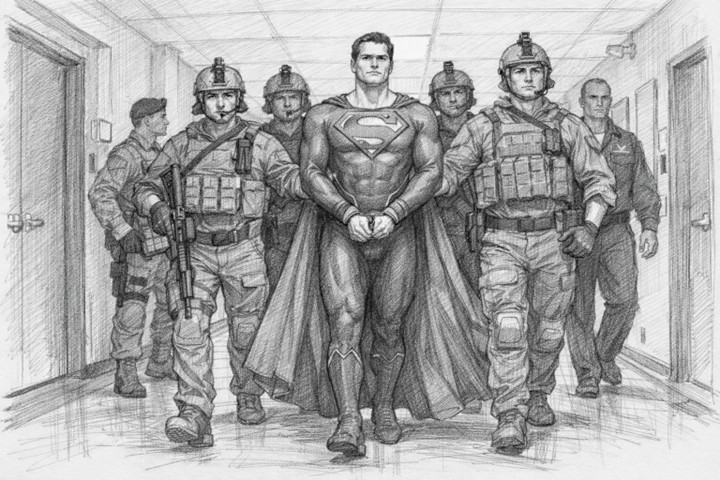
Growing up, Superman was my favorite everything: comic book hero, cartoon character, action figure, lunchbox mascot—you name it. I won’t deny this was in part due to the sensationalism that necessarily surrounds a creature who has every imaginable power and only one remote, impossibly inconvenient weakness. However, I was also captivated by a hero whose power so far exceeded that of his peers and enemies that killing them could literally be accidental—and yet he would not kill. Superman had the power to destroy, and the goodness not to; his restraint was more compelling than his strength.
One of the men who played at being my dad for a few years had a hi-fi set. When I lived with him, the dual speakers (and having two was state-of-the-art) were taller than me. Some of my prized possessions as an eight-year-old boy were vinyl records of the original Superman radio broadcasts. I listened to Superman and the Attack of the Killer Bees so many times it wouldn’t play properly anymore.
Max Fleischer’s animated masterpieces are among my earliest television memories. While I was indisputably fanatic, this wasn’t a fad for me. By the time I was a high-school senior, I’d taken to drawing Superman in different heroic poses on all the binders for each of my classes.
Around this same time—my senior year, that is—Superman gave me a lesson in the history of propaganda. Ubermensch was originally the apex of Nietzschean philosophy: an imaginary man who knows there is no God and still obeys a rigid, self-imposed moral code. By the 1930s, Germany’s Nazi Party had executed a nominal conquest of the word Ubermensch and turned it into a euphemism for Aryan and Nazi.
In 1935, Jerry Siegel and Joe Shuster pitched Superman as a comic about a bald villain, not unlike Lex Luthor. Superman is an English adaptation of the German word Ubermensch. They sought to propagandize against the Ubermensch in the American market via their villainous Superman.
While I’m often in favor of taking shots at Nietzsche and always in favor of taking shots at Hitler and his Nazis, Superman’s creators learned a hard lesson: you can’t sell a comic with an evil protagonist in 1930s America. Rather than give up, Siegel and Shuster did a complete rebrand, and the resulting character—beloved by millions—is now working on his ninth decade.
To say I was hyped for the debut of Superman Returns in 2006 would be an understatement. IMAX was an expensive novelty for rich city-folk, and to date this remains the only title for which I’ve ever traveled four hours or sought out a specialty theater. And to say I was disappointed in the plot would be another understatement. When Lois’ asthmatic son breaks a steel door and the audience collectively affirms what we’d been suspecting—namely that Superman, the Man of Steel, the Bearer of Hope, who stands for Truth, Justice, and the American Way, is an absentee father—the reveal comes like a gut punch. The movie had smelled sour for the preceding two hours as it toyed with the idea.
The character I knew had been wronged by his writers. I found the whole thing distasteful enough that I ignored the franchise for almost two decades… until one day in 2020, when a co-worker casually recommended Man of Steel.
“I really enjoyed it. I want you to watch it and tell me what you think.”
“I don’t know, man. I’ve been off Superman since high school. That whole absentee-dad bit kind of killed it for me.”
“Give this one a try. I’ll loan it to you. If you don’t like it, you’re not out anything.”
I was astounded. To this day, Man of Steel remains one of my favorite movies. It is an epic, in the classical sense of the word, about self-control. Today we think of “epic” as meaning big or cool, but it didn’t always mean that. Modern usage has transposed an accidental property of epics into their essential one. An ancient epic was a story that took an aspect of morality and presented it as something for the audience to practice and emulate.
Homer’s Iliad and Odyssey are epics of cunning. Beowulf is an epic of strength. The Lord of the Rings is an epic of contentment. These stories cast their heroes against demi-gods and dragons; the obvious might of the opponent magnifies the cunning of Odysseus or the strength of Beowulf, just as the great allure of the Ring of Power magnifies the contentment of Sam Gamgee.
We see Clark’s self-control blossom in layers. First, he must control his reflexes and senses. Second, he must control his anger and emotions. Finally, he must learn the measured use of violence. Clark’s demeanor serves as a reliable thermostat for his developing self-control. Early in the movie—and early in Clark’s life—his troubles are small: kids pick on him, a school bus falls into a river, someone throws a beer at him. In these scenes, he wears anger and confusion plainly on his face.
Later, after his training is complete and he has grown into a practiced self-control and sense of identity, Clark bears serenity and even a smile against increasingly impossible odds. Aliens as powerful as himself seek his life. They threaten humanity—a humanity that fears and misunderstands him. Zod attempts to turn Earth into a hellscape inimical to its own indigenous life. All the while, Clark faces these greater problems with the expression of a man well-rested and content. Cavill’s grasp and execution are exquisite.
In Proverbs, Solomon tells us: “He that is slow to anger is better than the mighty; and he that ruleth his spirit, than he that taketh a city.” Approximately 980 years later, the Stoic Seneca echoes his forebearer in the art wisdom: “Most powerful is he who has himself in his own power.” If Snyder set out to provide a case study that self-control is a mighty thing and worthy of our practice, then Clark must face temptations and frustrations that demand restraint. The greater the obstacle Clark successfully faces, the greater his self-control—and the greater a virtue self-control proves to be. In an age that confuses impulse with authenticity and power with entitlement, Superman’s restraint is not outdated—it is corrective.
S. D. Davis
Man of Steel | Superman self-control | Christian analysis Man of Steel | Stoicism Superman | Biblical self-control | Superman restraint | Man of Steel Christian review | Solomon Seneca self-control | Christian Stoicism | Superman epic self-control | Man of Steel themes | Biblical wisdom Superman | Clark Kent self-mastery | Proverbs self-control | Stoic restraint in film | Apostoic
More Articles For You:
The Emperor and the Two Governors: A Christian – Stoic Parable of Sequence and Causation – Apostoic
Robert Morrison and the Day of Small Things: One Secret Baptism That Changed Millions—and Why Your Small Voice Matters in the Culture War – Apostoic
S.D. Davis Socials
Facebook:
https://www.facebook.com/profile.php?id=100011203688273&comment_id=Y29tbWVudDoxMjIxMTc1NjExNjMxNjAxNDZfOTAzNDc1MzM1ODgyNjY5
Linkedin:
https://www.linkedin.com/in/samuel-davis-hwial/
Apostoic Socials:
Blog: https://apostoic.com
X: @DSpencer_blog
Facebook: https://www.facebook.com/profile.php?id=61584804386705
Instagram: @apostoic
This blog lives entirely on reader support. If it’s worth your time, it’s worth a penny in the tip jar. All proceeds to go ad campaigns to spread these articles across the net.


Leave a Reply